Key Design Points and Engineering Applications of Space Frame Structures
更新時間:2026-07-24 15:12:21?點擊:204 ? Grid Knowledge
1. Structural Definition
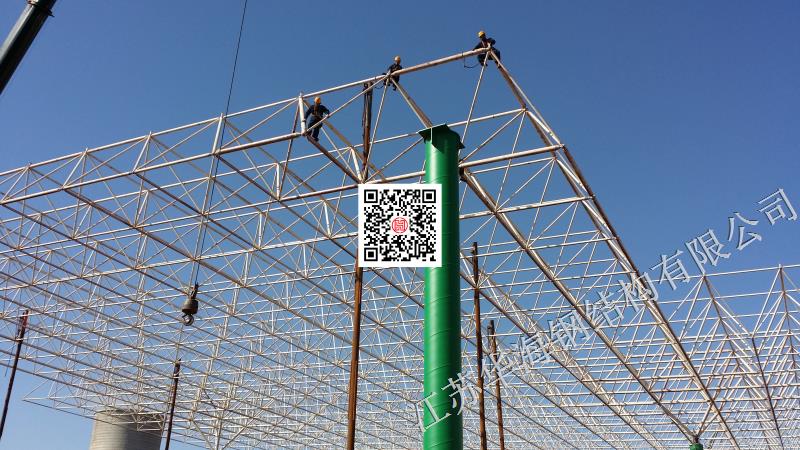
A space grid structure is a spatial bar system composed of multiple steel tube members arranged in a regular grid pattern and connected by joints, which is defined as a three-dimensional truss system. Compared with traditional planar trusses, it upgrades the unidirectional planar force bearing mode to integral spatial force bearing. The structural members mainly bear pure axial forces with negligible bending moments, achieving high steel utilization efficiency and reasonable mechanical performance.
2. Basic Classification
2.1 Classification by Grid Form
1. Double-Layer Flat Space Grid (Most Commonly Used in Engineering)
It forms an integral spatial grid consisting of an upper chord layer, a lower chord layer and intermediate web members. Featuring high structural rigidity and wide adaptability, it is applicable to most conventional long-span roof projects.
2. Triple-Layer Space Grid
An intermediate force-bearing layer is added on the basis of the double-layer grid, which further improves the overall rigidity and spanning capacity. It is mostly used for ultra-long-span and heavy-load working conditions.
3. Double-Layer Curved Space Grid
It includes special-shaped curved forms such as spherical surfaces and hyperbolic paraboloids. With flexible modeling, it is mainly applied to long-span dome buildings.
2.2 Classification by Joint Form
1. Bolted Spherical Joint Space Grid
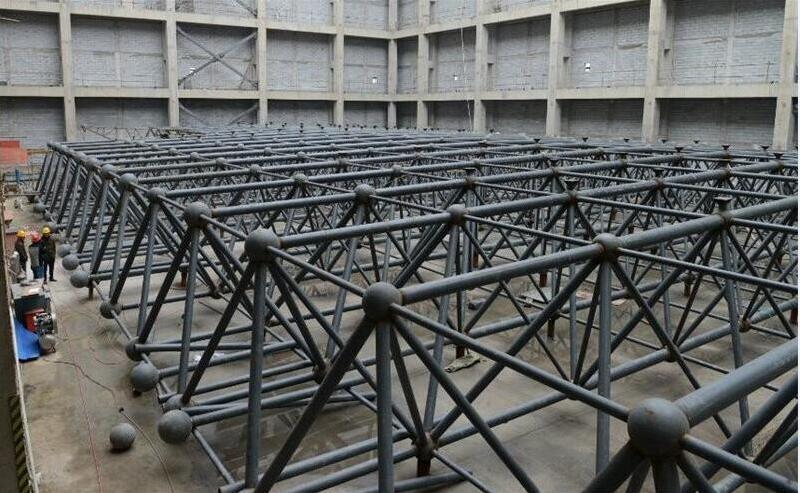
Bolt heads are arranged at the ends of members, which are assembled and connected to bolt spheres through high-strength bolts. It features standardized factory production, convenient on-site installation and short construction period, serving as the preferred form for medium and small-span space grids.
2. Welded Spherical Joint Space Grid
Member ends are directly welded to hollow spheres. This type of joint has high rigidity, strong overall bearing capacity and good structural integrity, which is preferentially adopted for long-span and heavy-load space grid projects.
3. Core Design Points (In Accordance with JGJ 7-2010 Technical Specification for Space Frame Structures)
3.1 Member Section Design
Steel tubes are the main material for space grid members. The specification stipulates that the wall thickness of steel tubes for conventional medium and small-span bolted spherical space grids shall not be less than 3mm. Restricted by the meshing length of bolt threads, the minimum wall thickness commonly used in engineering is 4mm, and the wall thickness shall not be less than 4mm for large-diameter bolt connections. The specific values shall strictly comply with the specification provisions.
Slenderness Ratio Control of Members: Compression members ≤ 150; Tension members ≤ 250; Under vibration load conditions, tension members shall be strictly controlled within 200.
3.2 Joint Design (Core Key Point)
1. Bolted Spherical Joint
Core control parameters: bolt diameter, net section diameter of the sphere, and bolt thread length (meeting the specified screwing depth requirements). Among them, bolt diameter is the core parameter determining joint bearing capacity.
2. Welded Spherical Joint
Core control parameters: wall thickness of hollow spheres, weld strength (designed in accordance with equal-strength matching principle), and quality of factory and on-site welding procedures.
3.3 Overall Stability Analysis
Overall stability verification is mandatory for space grid structures, adopting the combined method of linear elastic analysis and geometric nonlinear analysis. In accordance with Clause 5.3.1 of JGJ 7-2010, the elastic overall stability safety factor K of conventional double-layer flat space grids shall be no less than 4.2.
Special verification shall be carried out for the ultimate stability bearing capacity considering structural initial defects and geometric nonlinear effects, and the detailed calculation provisions shall be subject to the original specification text.
3.4 Support Design (Key Hidden Control Point)
Rubber bearings and spherical hinge bearings are commonly used for space grids. The design shall meet the requirements of structural horizontal displacement and rotational deformation, and fully consider the adverse effects of temperature stress.
As a highly statically indeterminate spatial structure, space grids are far more sensitive to temperature stress and uneven support settlement than ordinary trusses and beam structures. Improper selection and design of supports will easily cause overall structural deformation or even failure, which is a crucial and easily overlooked control point in space grid design.
Recommended Reading
-
History and Origin of Space Frame Structures
2026-07-21 11:32:35?219 次
-
Does higher zinc content in coatings for space frame anti-corrosion mean better anti-corrosion perfo
2026-06-22 10:32:13?19210 次
-
Construction technology of spherical grid
2021-01-29 14:15:02?8869 次
-
Advantages of bolted ball grid structure
2021-01-29 13:52:26?2977 次


